What Does Thread Count Actually Mean? (And Why Higher Isn't Better)
TL;DR: Thread count is the number of threads woven into one square inch of fabric. It stopped being a useful quality signal once manufacturers found ways to inflate it. Past roughly 400, the number tells you very little, and the fiber and weave tell you almost everything. A well-made 250-thread-count sheet can feel better than a 1,000-thread-count one.
Walk down a bedding aisle and thread count is usually the largest number on the package. It is printed in bold, it is the first thing a salesperson mentions, and it has quietly become shorthand for quality in a way the textile industry has never really earned.
The number is real and it does measure something. It just does not measure what most people think, and it has been gamed thoroughly enough that two sheets with identical thread counts can feel nothing alike. Here is what is actually going on.
What Thread Count Measures
Thread count is the number of threads in one square inch of fabric, counting both directions: the threads running lengthwise (the warp) and the threads running across (the weft). A sheet with 125 threads each way has a thread count of 250.
That is the whole definition. It is a density measurement, not a quality measurement. It tells you how tightly packed the weave is and nothing at all about what those threads are made of, how well they were spun, or how the fabric was finished.
How the Number Gets Inflated
The gap between what thread count measures and what shoppers think it measures created an obvious incentive, and the industry took it.
The main technique is multi-ply yarn. Instead of using a single strong thread, a manufacturer twists together two, three, or four thinner, weaker threads and counts each strand individually. A sheet genuinely woven at 250 threads per square inch using four-ply yarn gets marketed as 1,000 thread count. The number quadruples. The fabric does not improve — and because the individual strands are thinner and weaker, it often gets worse.
This is why a 1,000-thread-count sheet can feel heavy, stiff, and warm rather than luxurious. You are not feeling density of quality. You are feeling a lot of mediocre thread packed into a small space.
There is also a practical ceiling. Beyond a certain density you physically cannot fit more threads into a square inch without making them so fine they compromise durability. Counts advertised above roughly 800 are almost always ply-inflated.
What the Ranges Actually Mean
| Thread count | What it usually indicates |
|---|---|
| Under 180 | Loosely woven; often coarse and less durable |
| 180–400 | The range most well-made sheets fall into, across fiber types |
| 400–800 | Can be legitimate, but increasingly likely to involve multi-ply yarn |
| Over 800 | Almost always inflated; treat the number as marketing |
Worth noting: these ranges apply to cotton, which is where the thread count convention comes from. For other fibers the number is even less meaningful, because the fibers themselves behave differently at the same density.
What Matters More Than Thread Count
The fiber. This is the single biggest factor in how a sheet feels. Cotton, linen, viscose, and polyester behave differently against skin regardless of how densely they are woven. Our comparisons of bamboo viscose vs. linen and bamboo viscose vs. microfiber go deeper on how much the material determines the experience.
The weave. Percale is a simple over-under weave that tends to feel crisp and matte. Sateen floats more threads on the surface, which tends to feel smoother and look glossier. Twill uses a diagonal structure that produces a soft drape and tends to resist wrinkling. Two sheets at the same thread count in different weaves are two different products.
The finish. How fabric is treated after weaving affects softness, drape, and how it holds up through washing. Some finishes wash out after a few cycles, which is why a sheet that felt wonderful in the store can feel ordinary a month later.
The construction. Fitted sheet depth, seam quality, and elastic all shape how the set performs in daily use. Our guide to deep pocket sheets covers the fit side of this.
Why Our Sheets Are 250 Thread Count
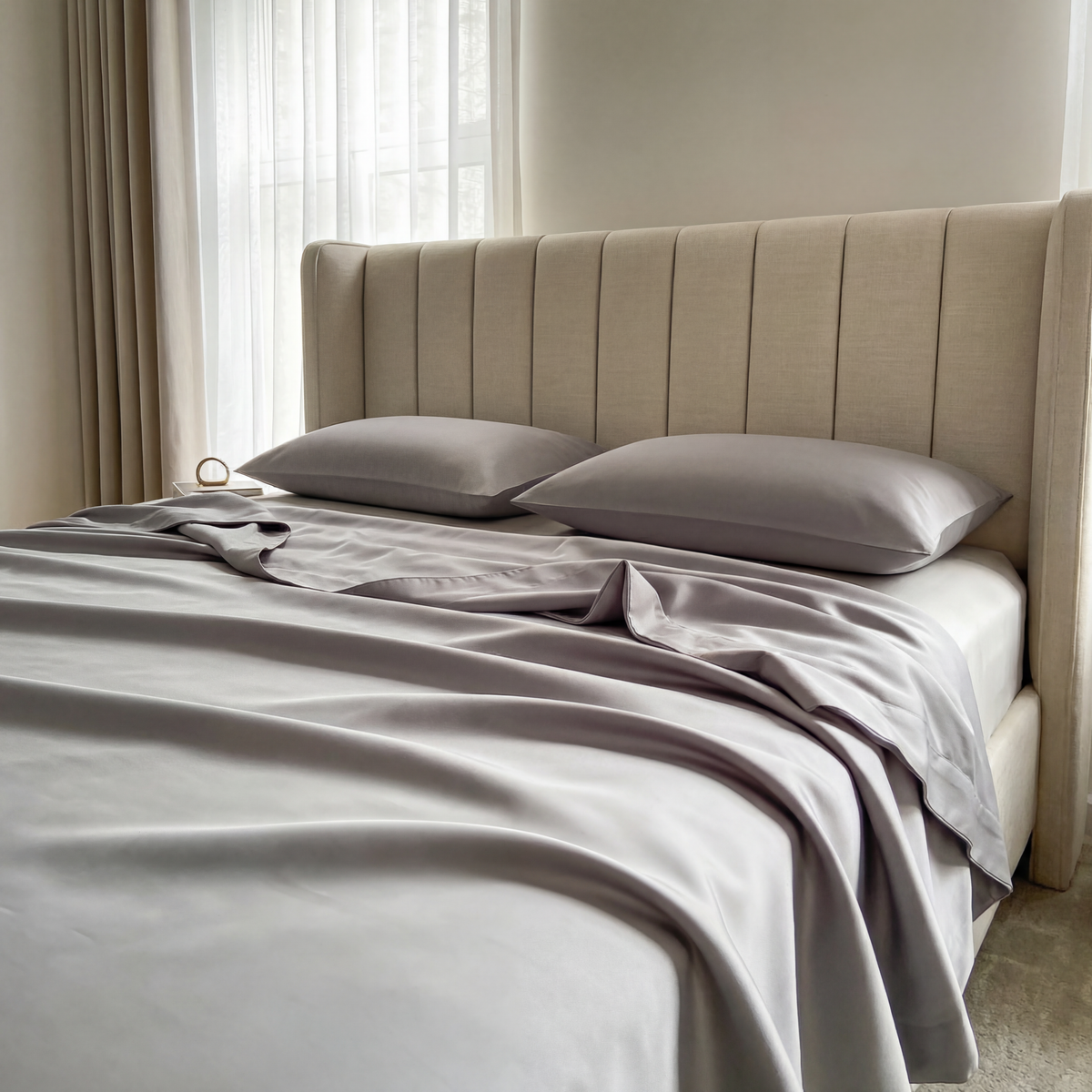
Our Bamboo Viscose Sheets Set is a 250-thread-count twill weave made from 100% bamboo viscose (rayon from bamboo viscose). Next to a package advertising four figures, that number looks modest. It is a deliberate choice.
Bamboo viscose fibers are naturally fine and smooth, so the fabric does not need extreme density to feel soft — the softness comes from the fiber itself rather than from packing more thread into the weave. A lighter, less dense construction also drapes more fluidly and stays more breathable, which is much of the point of choosing viscose in the first place.
Pushing the count higher would mean either finer, weaker threads or multi-ply yarn. Both would produce a bigger number on the label and a heavier, stiffer sheet on the bed. That is a trade we are not interested in making.
Each set includes a fitted sheet, a flat sheet, and two pillowcases, in Queen, King, and California King. Additional matching bamboo viscose pillowcases are available separately.
Frequently Asked Questions
What is a good thread count for sheets?
For cotton, most well-made sheets fall between 180 and 400. For other fibers the useful range differs, and the number matters less than the material and weave.
Is 1,000 thread count better than 300?
Usually not. Counts that high generally rely on multi-ply yarn, where several thin threads are counted individually. The fabric is often heavier and less breathable than a well-made sheet at a lower count.
Does thread count apply to bamboo viscose sheets?
It can be measured, but it is a weaker signal than it is for cotton. Viscose fibers are fine and smooth on their own, so density contributes less to how the finished fabric feels.
Does a higher thread count last longer?
Not reliably. Durability depends more on fiber quality and yarn strength, and multi-ply yarns used to inflate counts are individually weaker. How you launder your sheets matters at least as much — our guide to why sheets pill covers the habits that shorten a sheet's life.
What is the difference between percale, sateen, and twill?
They are weave structures. Percale is a simple over-under weave that tends to feel crisp. Sateen floats threads on the surface for a smoother, glossier finish. Twill uses a diagonal structure that tends to drape softly and resist wrinkling.
Explore Pure Fiber bamboo viscose bedding and judge it by how it feels, not by the number on the package.